Saturday, 1 October 2011

Saturday 1st October: Polgigga Twice & Nanquidno

Today the weather was full-on gorgeous. There was none of the mist or fog and it was much calmer so it was great to be out and about. With nothing in particular that I wanted to chase down I was in no hurry to get out this morning so instead had an extended morning painting session and it wasn't until about 10:30 that I started to think about where I wanted to visit. With no RBA updates so far to provide any clues I decided that I would head over Polgigga way to see if I could find anything good myself. On the way I stopped in at Sennen Cove to check on the Snow Bunting but there was no sign of it. As I was driving through Sennen just near the church I spotted a Turtle Dove just by the side of the road though it flew off as I drove past.

I parked up at Trevilley and started walking over to Polgigga via the footpath that goes through Nanjizal valley. I soon came across a Clouded Yellow flitting around in one of the fields. On my journey I saw loads of Wheatears and there were plenty of Meadow Pipits buzzing around as well. I was particularly looking out for Short-toed Larks and rare pipits for which this area is a bit of a hot-spot though without any luck. I grilled all the starlings on the wires at the lane but there was no sign of the Rose-coloured Starling though it hadn't been seen yesterday either. Next I walked along the footpath that heads west from Higher Bosistow as a couple of Dotterel had been reported in the recently tilled field there. I soon found the field but the only occupants were more Wheatears and six Skylarks. There was nothing further of note on my return journey.

I got quite excited at seeing this Clouded Yellow.
By the end of the day I'd seen half a dozen or so and realised
that they weren't actually that unusual.

I know very little about dragonflies but I
believe that this is a Common Darter

I had been thinking of heading straight back home but news had come through that the Hawfinch had been showing again at Nanquidno so I popped into a shop to buy a sandwich & drink & decided to eat them at Nanquidno whilst starting at some Blackthorn bushes in case the Hawfinch should decide to pop out of them. I arrived to find the car parking area almost full and John Chapple there staring intently into the field opposite. It turn out that he was watching a trio of Yellow Wagtails which were following the horses around the field as is their wont. Yellow Wags are hard birds to come by in Cornwall so I was pleased to get this county tick. I went over to the Hawfinch area where in the company of a couple of visting birders we waited and watched. After a while I decided to try a bit further down and left the others. Soon after they started gesticulating wildly to me so I ran back only to discover that it had shown briefly but had disappeared again. Having seen the bird the other two went off but I stayed put, being joined by John, Laurie Williams and a few others whom I didn't know. We passed a very pleasant hour or so chatting away and during this time John picked out a pair of Redstarts on the hillside opposite, again not an easy bird to see in Cornwall and yet another Cornish tick. John said that he charged half a pint per county tick and a pint for a lifer so that was already a pint I owed him, an absolute bargain as far as I'm concerned. A number of siskins flew over and I saw four more Clouded Yellows whilst waiting for the finch so it was clearly a good day for them. Back in the car park the lovely Pied Flycatcher was showing again by the car. However my afternoon painting session was long overdue so I headed for home.

The Nanquidno Pied Flycatcher, still as lovely as ever!

I'd just walked in the door when I got a text from Dave Parker saying that there was a Tawny Pipit down at Polgigga. After a couple of phone calls, one to Dave and another to Paul St. Pierre, who'd actually found the bird, I decided that I would have to have a try for it though it was getting late and I'd still not done my afternoon painting. Still you can't turn down the chance of a Tawny Pipit so I sped back off towards Polgigga, parked at Trevilley once again and yomped quickly down to Nanjizal. I soon found the exact field were Paul had found the bird and spent a good hour searching carefully down each furrow but apart from a load of Wheatears there was nothing else. There was one moment of excitment when one of the Wheatears started flying low and fast towards me. At first I couldn't work out what was going on until suddenly a Sparrowhawk appeared and took the Wheatear in a puff of feathers before flying off with his prize. A sad end to such a lovely bird but very exciting to see the hawk make its kill. As it was getting dark I eventually headed back to the car, scouring the other large earth field carefully on my way back but to no avail. Back home I had to put in a good evening painting session to compensate for such a long day out but with two county ticks I couldn't really complain.

Back by popular demand (well Badger likes it) is the "Moth du Jour" section. Today's offering is a Setaceous Hewbrew Character (ID as always courtesy of John Swann). My mothing consistes of turning on the outside light in the evening, catching what I find in the area in a glass, taking it inside to photograph and then releasing it again.

Friday, 30 September 2011

Friday 30th September: Mostly Nanquidno & a Bit of Sennen

This morning I awoke to find a reasonably thick fog enveloping Pendeen. A quick check on the Land's End webcam revealed that this wasn't just the regular local fog but something more extensive. Accordingly I was in no hurry to get out birding but first put in a decent session of painting. By mid morning things had started to brighten up somewhat so I headed over to Nanquidno to see what I could find. I was particularly interested in a Hawfinch sighting from the previous day and I also wanted to check the fields up by Little Hendra for Ortolan Buntings as this seemed to be a regular spot for them.

I'd forgotten just how many more birders there are down on the Penwith peninsula in October and whereas a month or so ago I could more or less have had the valley to myself now there were quite a few cars parked in the parking area and quite a few birders about though no one had seen anything. I gave the blackthorn a good grilling as apparently that was where the Hawfinch had been yesterday feeding on the sloe berries but to no avail. Up by Hendra House there was a huge flock of several hundred linnet with some goldfinches in amongst them and I spent some time searching through them for something rarer but again without any luck. On the way back up the valley I spotted a Peregrine sitting high on a rock surveying the surround area. Back at the ford I bumped into Dave Parker briefly who'd not seen anything of note either. I decided to round off my rather fruitless visit with a quick yomp over to Tregriffian Farm where the long-staying Pectoral Sandpiper had been remaining faithful to the small muddy pool at the back of the farm. Sure enough he was still there and I took a few photos though it was still misty and the light was poor. Then it was back home for lunch and my afternoon painting session.

It's quite remarkable how small the pool is that
has kept this Pec. sand happy for several days now

With no news of anything major to hand I wasn't sure where to go for my afternoon birding expedition so when the Snow Bunting was reported as still being present at Sennen Cove I thought that to start with I would head over in that direction. I decided to have an explore along the north end of the Cycle Track that goes to Land's End and had just started out when I met a couple of birders who mentioned that not only had the Hawfinch been seen again at Nanquidno but also there'd been a Pied Flycatcher there as well. I quickly decided to head back there to see if I could catch up with either of these birds and cut short my Cycle Track walk. On the way over to Nanquidno I nipped into the upper Pay & Display car park where sure enough the Snow Bunting was hopping around in the middle of the field as confiding as this species usually is. I took a few shots from the car window and then headed back to Nanquidno.


The Sennen Cove Snow Bunting

As I pulled up in the parking area there were a couple of birders staring intently into the Sycamore trees there and it turned out that they'd just been watching the Pied Flycatcher and told me that it was appearing regularly at this spot. I settle down to wait for its reappearance but unfortunately it wouldn't cooperate and after about half an hour I decided to try my luck with the Hawfinch instead. There were quite a few birds moving around in the Blackthorn including several Chiffies and a male Blackcap but no sign of the target finch. Back to the car park: still no flycatcher. A quick walk to the ford: nothing. Back to the car park: bingo - there it was! I took some snaps and watched it for a while. I know that Cornish locals don't get too excited about Pied Fly's which are fairly regular down here but back in Oxon they are very hard to get and this was a Cornish tick for me so I enjoyed watching this dainty little flycatcher. After a while I had one more fruitless try for the Hawfinch and then headed off home for food and my evening painting session.


The Nanquidno Pied Flycatcher

Thursday, 29 September 2011

Thursday 29th September: Lodmoor, St. Clements & Land's End

Back down to Cornwall for another week of frenzied painting (this time it's all the windows) and birding. As usual I'd been keeping a keen eye on what was about in Cornwall: there were still some hangers on from the initial batch of Nearctic waders with a couple of Lesser Yellowlegs (Drift & St. Clements, near Truro) and a Long-billed Dowitcher at Stithians Reservoir. Unfortunately the long-staying Drift Semi-P had chosen to move on and with just a few days until my arrival the Drift 'legs also departed. As usual I looked about for something to stop off at on the way down and my chosen route for the journey was as follows: Lodmoor in Weymouth for the Red-backed Shrike (as far as I'm concerned Weymouth counts as "on the way"), St. Clements for the Lesser Yellowlegs and finally Stithians Reservoir for the Dowitcher.

I set off earlier a little after 8 a.m. and after negotiating the Oxford morning rush-hour traffic I was finally on the A34 at around 8:30 when after an uneventful journey I arrived at Lodmoor mid morning. Red-backed Shrikes are very hard to come by in land-locked Oxfordshire so I was happy to make a bit of an effort to go and see one. This turned out to be a very easy twitch and within five minutes of stepping out of the car I was watching the bird from a range of about 50 yards in what were rather hazy conditions because of the bright sunshine. I spent a little while taking some digiscoped record shots though the haze meant that the results weren't that great. The wader scrapes themselves seemed rather empty with just a single greenshank, one bar-tailed godwit, one grey plover and 5 dunlin around. Having seen my bird and with a lot of driving on relatively slow roads ahead to get back on to the main route, I didn't hang about but pressed on for Cornwall. En route I got a text saying that there was no sign of the Stithians Dowitcher though the St. Clements Yellowlegs was still around.

The Lodmoor shrike, digiscoped in rather hazy conditions

In good time I arrived at my next destination of St. Clements. This turned out to be a small village on the edge of the River Tresillian which was rather wide and with the tide right out consisted of a vast area of mud. There was a pool, called Tresemple where the bird sometimes hung out but I managed to find the bird on the main river almost as soon as I started looking. It was rather distant but having spent every day for a month watching "my" Lesser Yellowlegs on my home patch of Port Meadow this time last year I found that the dainty features and rapid feeding action leapt out at me even from across the river . In the scope I could make out it's lovely yellow legs though it was too far away for even me to attempt a photograph. Further up by Tresemple pool there were a total of 6 Greenshank and a Spotted Redshank as well as good numbers of Curlew and some loafing gulls.


As I didn't get any record photos of the bird here's some fantastic footage taken by (c) John Chapple

Back in the car I headed off for Stithians Reservoir and was just getting close to it when I got a call from Dave Parker saying that the Red-backed Shrike at Land's End was still about and showing well just below Swingates House. I thanked him for the message and resolved to head there straight after my reservoir visit. At the reservoir I couldn't believe at just how low the water level was with so much of what had been submerged now exposed. There I met a couple of local birders whom I'd met before who'd been there for the last two hours scouring all areas in search of the Dowitcher. I told them about the "No Sign" pager message which at least put their minds at rest regarding having missed it. By way of compensation there was a Wood Sandpiper around and a couple of Wheatears. They'd also seen a couple of Pecs and a flock of Dunlin though these all seemed to have moved off somewhere else by the time I'd arrived. Given how thoroughly they'd already searched for the bird I didn't hang around at all and within fifteen minutes I was heading off for Land's End.

I arrived at Land's End to find another birder just escorting his wife to see the shrike and he was able to show me exactly where it was hanging out so that in a few minutes I was watching it. In the evening sunshine it was bathed in a wonderful golden glow and without the haze from this morning I was able to enjoy fantastic views of this beautiful bird.


The shrike was slightly too far away for a super-zoom
shot so I had to be content with digiscoping though the light
was absolutely perfect.

Tired but very content with my journey down I headed off to the cottage to get unpacked and to russle up something to eat. It had been a most enjoyable start to my time back down in Cornwall.

Sunday, 11 September 2011

Sunday 11th September: Homeward Bound

Sunday morning it was time to pack up and head off home. Of course I stopped in at Hayle briefly but there was nothing of particular note and my journey back home was uneventful. Just as I got back into Oxford I stopped off at Farmoor for a quick wander round to stretch my legs after the long car journey and to have a quick scour through the wagtails on the off chance the citrine had returned but of course there was no sign of it. The white-winged black tern, a confiding little stint and a black-necked grebe were all still on show which were nice to see.

Looking back, despite my initial reservations I'd enjoyed some good birding down in Cornwall. Highlights had included three pectoral sandpipers, a Baird's sandpiper, a buff-breasted sandpiper, a couple of great shearwaters, a Leach's petrel and a black kite. It never ceases to amaze me just how many Nearctic waders they get down in Cornwall. Whilst I was there there were 7 pectoral sandpipers, 3 buff-breasted sandpipers and 1 Baird's sandpiper and since I've come back there have also been greater and lesser yellowlegs, semipalmated sandpiper and I've lost count of the buff-breasts now, it's quite remarkable. Oxon on the other hand has had a good autumn so far with a single pec. sand and is still awaiting its first buff-breast and Baird's. Anyway, I can't wait to get back down to Cornwall and I feel that there will be more decorating required in the next few weeks.


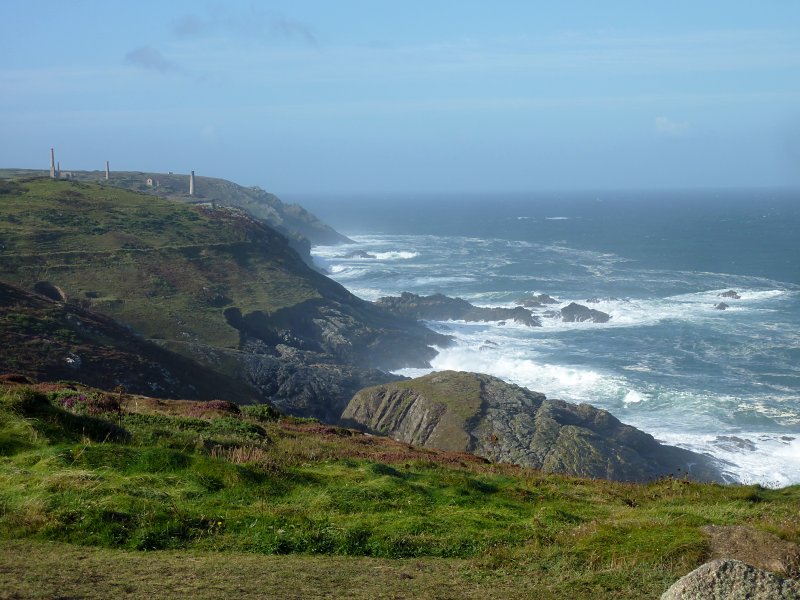
My favourite view at Pendeen, looking rather stormy and misty

Saturday, 10 September 2011

Saturday 10th September: Porthgwarra & Nanquidno

Saturday had originally been forecast for very strong winds. In fact a couple of Oxon birders had been planning on coming down for it though as the day approached the forecast kept being downgraded so by the time it was Friday evening I suggested to them that it wasn't going to be the spectacular blow they were hoping for and indeed so it turned out: it was indeed windy but not enough to travel all that way just for one day. I decided that I would still pop down to Porthgwarra but as usual I would do my morning painting first of all.

I arrived mid morning to find a rather modest crowd assembled at Hella Point, mostly visitors, and to discover that it had been a very quiet morning. I settled down and after a while someone picked out a great shearwater which was reasonably close. Apart from that there was one close arctic skua, a sooty and a few bits and bobs, all rather quiet though some of the visitors were very pleased to get the great shearwater. After a while the sun moved round so the whole of the sea was very brightly lit and it became very difficult to see anything. I now started to appreciate why the Sea-Watch South West team stop between 12 and 2 each day: it's just impossible to sea-watch if there is any sun on the water when looking due south. I therefore took the opportunity to explore the moor instead to look for the wryneck which had been reported the last few days. I initially scoured the gully just round the corner from the Coastguard Lookout but with no luck so I decided to head over to the Dried Up Pool. As I was wandering down the middle of the three tracks that lead to the Wall I spotted a moth fluttering about by the side of the path. As readers will know, I know next to nothing about moths but am interested enough to photo any that I do come across and I generally try to work out what they are (usually by asking John Swann!). It was a very striking white moth with small black and orange dots on it. I soon forgot about it and went back to my wryneck hunting though once again I had no luck with it. I did hear a rasping fly-over call which had me thinking citrine wagtail though it only called once and I never saw the bird. As I was wandering around I started to get texts from people back at Oxon: apparently a first winter citrine wagtail (a county first) had been found at Farmoor reservoir and I felt suitably gripped off at missing it. After a while I trudged back to the sea-watching point to learn that things hadn't improved since I left.

The moor is still looking very pretty with a lovely contrast
between the purple heather and the yellow of the gorse.

whilst not finding the wryneck I came across this
toad in the middle of the path

At that point I decided to head off home and was just walking past the coastguard cottages when I got a text from Dave Parker saying that a black kite was lingering over Najizal valley. That wasn't far from where I was so I got out the scope on the off chance that I could spot it from where I was and blow me, there it was! It was soaring over in the Najizal direction being mobbed by a kestrel and with a buzzard for company. I watched it for a few minutes as it appeared to move into Porthgwarra air space over the moor though at the far (Nanjizal) end. I sent Dave back a text saying where it now was and then headed back to the car and headed for home, pleased with the bonus kite sighting which went some way to compensate for the Oxon citrine grip-off.

As I was nearing St. Just airfield I got a Bird Guides text saying that the wryneck had been seen that day at Nanquidno still so on impulse I turned off to take a look. I decided that I would stake out the spot for a while and spent at least and hour and a half staring into the bracken and brambles but to no avail. There was a peregrine buzzing around and the chough were still there but that was about it. Various other birders came, stared unsuccessfully and went off again before I too gave up. As one of them put it "wrynecks, they're right buggers!".

Back home I had plenty of painting to be getting on with as I was intending to head back home tomorrow so I needed to finish everything off. That evening I was checking up on sightings on Cornwall Birding where I spotted a reference to a Crimson Speckled Moth which had been seen at Porthgwarra. This reminded me of the moth that I photographed earlier in the day so I Googled the image and low and behold this was indeed what I'd found. I guessed from the fact that it had been mentioned on the web-site that it must be quite a rare moth and after exchanging some e-mails with John Swann I learnt that in fact it was a Mega in the moth world and that the last one that had been seen in Cornwall was in 2006. It's a shame that the full impact of its rarity is lost on me: had it been the bird equivalent I would have been suitably elated but I've not knowingly seen most of the commonest of moth species and this was just another one that I didn't know though I would definitely recognise one if I saw it again.


Here's the Mega moth: a Crimson Speckled Moth,
possibly the rarest thing that I've found to date!

Friday, 9 September 2011

Friday 9th September: Nanquidno & Hayle

I woke this morning to more fog and little wind so once again there wasn't going to be any sea-watching on offer. Once again I did an extended morning painting session to give the fog a chance to lift and then for a change I thought that I would go to Nanquidno where a wryneck had been reported for the last few days. I also wanted to explore the valley a bit further as I'd only ever birded around the ford area previously so this would be an opportunity to get to know the area a bit better.

At around 10am I arrived, parked up and headed down the valley. There were plenty of birds around, mostly mixed flocks of tits and chiffchaffs which I grilled for something more interesting but to no avail. Down at the wryneck spot I met a couple of other birders, from Southampton but who had a place in Penzance and we had a good chat. They'd been there for a couple of hours but there had been no sign of the wryneck though they had seen a pair of spotted flycatchers. Given their lack of success I decided not to bother staking out the area for very long and instead made my way over to Little Hendra which is a place that I'd heard of in the past for things like ortolan and lapland bunting in the various fields but had not visited before. This was also an opportunity for me to test out my new OS map app on my phone: it gives you an OS map and a "you are here" spot which makes it very easy to navigate your way on footpaths and tracks as it updates in real time. As long as you have a phone signal it works really well and I soon managed to navigate my way to Little Hendra where indeed there were plenty of good looking fields around though they were all empty apart from a few rooks. A couple of juvenile green woodpecker (not such a common bird on the peninsula) flew over as did a sparrowhawk and a couple of calling chough but apart from that it was all quiet. I made my way back to the wryneck spot (still no sign) and then back to the car and home for lunch.

That afternoon it was back to Hayle once more, this time to look for the little stint. I mentioned this in passing to Badger back in Oxon and he was amazed to learn that I had got pec., buff-breast and Baird's sands all before I'd got little stint in Cornwall - but that's Cornwall for you! It was quite a high tide today so there were no birds at all at the Hayle bridge and I decided to explore the Carnsew basin where Dave Parker had seen the stint yesterday. As I made my way along the sides of the Basin a sparrowhawk flew up and over the course of the afternoon I saw it a number of times as it made unsuccessful attempts on the roosting waders. A flock of 7 sandwich terns were flying around noisily and diving into the river. Up near the top of the Basin I met a birder who said that he'd just managed to find the Baird's sandpiper in amongst a group of waders that were on the seaward side of the Basin by the bend. When I asked he said that he had also seen a little stint in amongst them so I hurried on. Unfortunately it had started to rain quite hard and it was rather windy so viewing conditions were not ideal. As I grilled the waders a local called Brad turned up and we looked together though neither of us could find anything apart from the usual suspects though few birds had already started flying off from this location as the tide had now turned so it's possible that they'd moved off.

The palmations on it's foot got me excited for a moment until
I read up that ringed-plovers have small palmations between the
middle and outer toe too!


Some of the usual suspects on the estuary, taken
a couple of days earlier in better light (Click to enlarge)

As I was keen to find the stint I decided to work my way back towards the bridge and Ryan's Field to see if I could track it down. At the car wash I came across a group of birders peering intently into the gloom at the rapidly expanding area of exposed mud which the waders were repopulating as the tide ebbed. They were all looking for the Baird's though I asked them all if they'd come across the little stint. After a while one of them picked the stint out from the other waders and indeed there it was, albeit rather distant, another Cornish tick. I helped them to look for the Baird's for a while but to no avail though there was a nice mixed flock of terns on the estuary, comprising 15 arctic and 20 sandwich terns. Eventually it got too dark and we all went our separate ways. With another Cornish tick notched up I went back home for my evening painting session.

Thursday, 8 September 2011

Thursday 8th September: Drift, Hayle & Marazion

Thursday dawned, not with the strong winds that had been forecast at the start of the week but with hardly a breeze and instead a thick fog. Now Pendeen is especially prone to fog which is often very localised so if you go over the hill towards Penzance or further west you soon find yourself clear of it but this morning a quick check on some local web-cams revealed that it was actually quite extensive. With no prospect of sea-watching, today I thought that I would take the opportunity to catch up with some of the commoner waders that I still needed for my Cornish list. So after a prolonged morning painting session (to give the fog a chance to lift) I headed off to Drift reservoir where I was hoping for spotted redshank and ruff, both of which had been reported yesterday.

I arrived to find it still rather misty though clear enough at least to see to the far bank. As I walked along the bank I met a couple of birders who were leaving who reported seeing one of the juvenile pec. sands (the count had now gone up to four birds!). In the hide itself I found Dave Parker staking out the north-west arm. He said that he'd never seen the reservoir so low at this time of year though of course the resulting exposed shore line was great for waders. However the low water had exposed a small "cliff" which dropped off away from us as we were sitting in the hide so that there was a large area which was hidden to view. Consequently it was a matter of waiting until birds wandered out into view. There were plenty of ringed plover in view and a green sandpiper in the creek and Dave had seen a juvenile dunlin briefly. After a while the spotted redshank waded out into view giving me another Cornish tick before it went back out of sight. A couple of common sandpipers were working their way along the far bank. I spotted an Arctic tern hawking over the reservoir and then another flock of six birds came through. As it was just a matter of waiting we passed the time very pleasantly chatting away and Dave filled me in on past local birds and the local birders. After a while Paul Semmens joined us, apparently he does the birding commentary for the Scillonian crossing. As there was not much about he said that he would go and check the north-east arm which required going back up to Sancreed and then around to the other side. We asked, only half jokingly, if he could flush the birds from that arm back down to here and he said that he would see what he could do though it would take about half an hour to get around there. Sure enough within about half an hour we started to get some birds coming round to our side. First a pair of greenshanks, then a ruff and a knot came in and landed on the point very close by, the ruff being another Cornish tick. We were hoping that the smaller waders would come through but either he didn't manage to "flush" them (larger waders are usually more skittish) or they'd gone to another part of the reservoir. Eventually we'd had enough and walked back together with Dave taking the opportunity to point out some rare plants which had quickly established themselves on the exposed mud of the reservoir side.

A record shot of the knot and the ruff in the mist

Back home I did my afternoon painting session and then contemplated my afternoon birding outing. A buff-breasted sandpiper had turned up at Hayle and there was a juvenile pectoral sandpiper at Marazion. Moreover a juvenile little stint (which I still needed for the county) had been seen at Hayle the last few days so I thought that I would head off there for high tide once again. As I arrived, I had the pleasure of bumping into John Chapple, whom I'd met a couple of times previously at Treve Common (greenish & melodius warbler the first time and woodchat shrike and sub-alpine warbler the second) who was there with his camcorder looking for material for another of his superb videos (see his excellent blog). He was looking for the Baird's sandpiper whereas I wanted to pay my respects to the buff-breast so we went our separate ways. There were a few people looking at the buff-breast from the road side of Ryan's Field as it was at the back of the largest island there. As it was rather distant I had to resort to digiscoping rather than using the super-zoom but a few shots managed to come out OK.


Digiscoped shots of the buff-breasted sandpiper (Click to enlarge)

As there was no sign of the little stint, after a while I decided to head on back home but thought that I would pop in briefly at Marazion to check out Dave Parker's juvenile pec. sand. This was partly as it was on a part of the marsh that I wasn't so familiar with so at least it would be a chance to learn some more about the site. Just as I was walking down to the marsh I got a text from Dave saying that he was at Hayle and had just found the little stint all the way up at the North end of Carnsew Basin on the seaward side. I decided that it was too late to head back there now and carried on at Marazion. I soon found the standing stone by the pool on the eastern side of the marsh and sure enough there was the pec. sand skulking around at quite a close distance. The light was terrible but I had a go with the super-zoom and at ISO 400 managed to get a record shot or two.


The Marazion pectoral sandpiper (Click to enlarge)

After that it was back off home for food and more painting. It had been a good day with two more Cornish ticks and a couple of nice Neartic waders to boot.