Tuesday, 9 November 2010

New Cornwall Birding Reserve – Your help needed

A worthy cause which I thought that I would highlight. I've copied the text from from Cornwall Birding

As you may or may not know, Cornwall Birding is working with Sainsbury’s to secure land at Hayle which will hold a new food store and incorporate a superb new nature reserve which we will be managing. The reserve has great potential with plans for large areas of reed bed, open pools and wader scrapes with plenty of walkways, viewing areas and bird hides. It will be open to all, not a members only reserve! So we need your help in securing the planning. If you could spare just a few minutes composing a letter or e-mail to the address at the bottom of the page showing your support for the application, it would be greatly appreciated.

For a PDF version of the proposed plan click on the link here

Write or e-mail your support to:

PA10/04297: Proposed Foodstore off Marsh Lane Hayle
Jeremy Content
Development Officer
Planning and Regeneration (West)
Cornwall Council
St Clare, Penzance , TR18 3QW
Jeremy.Content@cornwall.gov.uk
Tel: 01736 336785
Fax: 01736 336566

4 possible grounds of support in no particular order:

1. A modern new foodstore serving Hayle, improving choice and competition and enabling Hayle residents to do their weekly food shop locally. The Harbourside is not an appropriate location for a foodstore in heritage and traffic terms.
2. Creation of 270 jobs and proper training for new colleagues.
3. A new nature reserve, with public access and co-ordinated management. A great local resource!
4. A green buffer between the development and Angarrack, protecting the amenity of the village for ever.


Here are a couple of photos from my recent visit to Pendeen. I'm hoping to visit again in the next few weeks though it does seem to have got rather quiet now.

My favourite view at Pendeen, looking south towards Land's End

Another point & shoot photo of the Cot Valley firecrest

Monday, 25 October 2010

Saturday 23rd & Sunday 24th October: Pendeen, Treen & Hayle

Having picked up the family on Friday night it was now a case of doing DIY and family-based activites so birding would be somewhat curtailed. On Saturday, since the rest of them like to lie in whereas I like to get up early I took the opportunity to nip down to Pendeen lighthouse for a spot of sea watching. There was a good strong north-westerly wind so ideal conditions for Pendeen. There I met half a dozen or so birders already present and busy doing a one-hour count. They were all calling out the birds as they passed and each person had a click-counter for a different species. I sat down with them and duly started calling out the birds that I spotted. It was all rather quiet with nothing but auks, gannets and kittiwakes. Indeed the highlight during the short time I was there was a fulmar that I spotted (apparently the first one of the day) though there had been a sooty shearwater that went through before I arrived.

I thought that I'd take a photo of the lighthouse from a different angle for a change.

I soon had to leave to get on with more mould removal whilst the rest of the family went for a walk down to the fishing cove just to the north of the lighthouse. I would periodically peer out the window and I could see that things had definitely picked up on the seawith huge numbers of gannets streaming past and in the bright sunshine I could even make out small white dots which could only be auks with their low direct flight. It later turned out that a little shearwater went past mid morning as well as a Leach's petrel, good numbers of skuas and a few shearwaters so I missed a really good session!

There were lots of "stormlets" passing through over the weekend: very small concentrated rain showers which pass through quickly. This one had a rainbow at one end

That afternoon the girls wanted to go shopping in Penzance so I took L (our four year old boy) for a walk down to Treen cliffs where a barred warbler was supposed to be hanging out. Being on the south cost of the peninsula it was nicely sheltered from the northerly wind and L and I passed a pleasant hour or so sitting around watching the sea and failing to see any warblers. I did spot a stonechat, a kestrel and a rather late house martin. Then it was back to rendezvous with the girls for a spot of tea in Penzance and then back home for dinner.

Sunday morning I went down to the lighthouse again though the wind was much more moderate and there was just one other birder there. There were loads of kittiwakes but not much else until I spotted a distant skua which we both agreed looked like a pomarine. A couple of balearic shearwaters also went through and my companion had seen a few distant auks which might have been littles. I soon had to get back for a final bout of mould scraping. Whilst I was doing this B (our younger daughter) and L went out to look for slow worms and they managed to find one as well as a tiny newt.

Slow worm: the children enjoy finding them under stones

After packing up it was time to set off for home via the scenic route along the west coast, stopping at Zennor for lunch at the hostel and Leylant Saltings where the girls visited the sweet shop and I had a brief scan of the estuary. I found the whooper swans but not the spoonbill though as we set off on the A30 I glanced down into Ryan's field (Hayle RSPB) where there was a large white sleeping bird which could well have been the spoonbill. Our journey home was uneventful and we arrived back at Oxford mid evening. It had been another enjoyable visit to this wonderful part of the country with some more great birds to see.

Saturday, 23 October 2010

Friday 22nd October: The Valleys and Sandy Cove

On Friday morning and with little wind forecast, rather than doing some sea watching first thing I decided to get over to Nanquidno and Cot valleys to see whether I could connect with any yellow-browed warblers. At Nanquidno a bird had been reported for several days in the copse by the ford so that's where I started. I met with a female photographer who was staying at the house right next to the ford. She'd seen the bird several times on previous days but not that day so far. I wandered around a bit and crossed over the stream to check out the other side. The habitat all looked great but the best I was able to come up with was a single firecrest.

Next on the Cot valley where I soon found another firecrest in the company of a goldcrest but once again no warblers. I met a fellow birder who'd found a couple more firecrests lower down the valley but he too had not had any warblers so I decided that I'd better get back to the cottage and start my DIY work. I did manage a photo of the Cot firecrest on my point & shoot camera which came out quite well.

The Cot valley firecrest

I spent the morning painting a grotty wall where a bookcase had been, the idea being to make the interior less revolting for when we come down to visit. There was also lots of black mould which was going to have to be removed later on. After lunch I had an appointment with the builder to discuss progress and after that I felt that another brief birding break was called for and duly set off for Sandy Cove in Newlyn where there was supposed to be a snow bunting hanging out. I soon found the bird which was as approachable as they usually are. Most of the area was in deep shade but there were a couple of sunlit areas and I was fortunate enough to get some photos off in this area so the bird was well lit and nice and close.


The Sandy Cove snow bunting

Whilst I was in the area I nipped down to Point Spaniard just past Mousehole where there was supposed to be a yellow-browed warbler. The copse habitat looked great though viewing was somewhat restricted. I met a fellow birder who'd been there for about an hour and a half without luck so it wasn't looking promising. We staked out the area for a while to no avail before I realised that I would have to get back for some mould scraping and departed. Back at the cottage I spent a couple of hours taking off the damp mouldy paint from the walls and after these efforts the wall looked a lot better. There's something really off-putting about seeing mould on your walls and bare plaster is infinitely preferable.

Friday, 22 October 2010

Thursday 21st October: Heligan & Sennen

As regular readers will know, we're doing up a cottage down in Pendeen and having not been down for a few weeks, it was time to return there to check up on what the builders had been doing to the exterior and to do a bit of work on the interior ourselves. The plan was that I would go down on Thursday and then the rest of the family would come down on the train on Friday night for the weekend.

I myself set off from Oxford shortly after 9am on Thursday morning as I wanted to drop in on some birds en route. Specifically there was the small matter of the first winter green heron at the Lost Gardens of Heligan that it would be rude of me not to visit and with the roads nice and clear I arrived there at around lunch time to find the weather down in Cornwall gloriously sunny and warm. I'd been prepared for cold conditions and found myself rather hot with all my layers on. At the entrance gate I enquired about the heron and was told that it was at the top pond today. This was how twitching should be: definite news of the exact location and even a map to show you exactly how to get there, well worth the £10 entrance fee! Some ten minutes later after a nice walk through some woodland and then down a little hill I arrived at what was a remarkably small pond. At the bottom end on a footbridge were a few photographers who told me that the bird was working its way around the pond and was just behind some reeds at present. After that it was just a matter of matter of waiting a few minutes while it worked its way out of the reeds and then trying to find the best angle to view from. The bird was regularly catching small fish so was obviously being well fed and I wondered whether it might actually try to over-winter there, only time will tell. This must be one of the most photographed herons in the country but here are my digiscoped efforts.


The Heligan green heron


I also took some video footage of the bird


After that it was on to the Penwith peninsula. I briefly dropped in at the Leylant Saltings platform for a scan across the Hayle estuary where there were supposed to be a spoonbill and some whooper swans hanging around. There was no sign of either though I did meet a local birder and I took the opportunity to ask him about the buff-breasted sandpiper that was at Sennen. He told me that it was hanging out with a flock of golden plover but that you can't see all the field from the official viewing point. Armed with this information I went off to Sennen and a short while later pulled up at the Trevedra farm entrance and walked down the farm track to the second field. Apart from a few loafing gulls there was nothing to be seen. What was apparent was that the field had quite a slope on it and one could only see part of it from this vantage point at the bottom end. Whilst I was there another party of people came, enquired about the bird and on hearing that it was nowhere in sight, went off again. Shortly after that a large flock of several hundred golden plover flew in, circled for a while and then landed on the hidden part of the field. Whilst they were flying I scanned the flock carefully but there was no sign of any smaller hangers-on. Having done my research (i.e. looking at Google Earth before I set off) I knew there was another farm track on the other side of the field so I duly set off there and from this vantage point I found that I could see the plover flock perfectly. There was no sign of the sandpiper initially but after a while it flew in calling loudly, landing quite close to me some thirty yards away. Although I was facing directly into the sun I adopted my usual "if I can see it I'll try to photograph it" approach and rattled off some digiscoped shots before it moved further away.


The Sennen buff-breasted sandpiper, all digiscoped into the sun so the bird is very back-lit

After having failed to connect with the Davidstow bird on a couple of occasions it was nice to see this bird comparatively easily. As I was returning to the car I met a fellow birder who said that the third winter Azorean yellow-legged gull, which had been hanging around the area for a while was also in the same field best viewed from the other track so I went back for a look. There was one gull which could have been it but before I could give it a good grilling a helicopter flew over and put up all the gulls. At this point I decided to call it a day so I drove off to Pendeen, unpacked the car and headed over to Tesco's to get some provisions for the duration of my stay. It had been a great start to my Cornwall visit.

Monday, 27 September 2010

Sunday 26th September Pendeen & Davidstow

Back at Pendeen watch first thing this morning where I met a husband a wife team of birders who were sea watching from the sheltered southerly side of the lighthouse so I decided to join them. Whilst this offered respite from the wind it did mean that the birds were further away and in future I think that I'll just have to brave the wind and sit in my usual spot.

dawn coming up over the hill at Pendeen
The Gurnard's Head at first light

Finally there was some activity on the sea with some shearwaters and skuas coming through. During the two hours that I was there as well as the usual stuff I counted ten balearic shearwaters, one sooty shearwater, about 6 arctic skuas including one really close in and one bonxie. I noticed that the rate of 5 balearics per hour was the same as was achieved at Porthgwarra that day. We also had three sightings of basking sharks though whether it was the same one or three different individuals is hard to say though at Land's End ten were reported.

I spent the next hour or so back at the cottage packing up and loading stuff in the car before setting off for home. I wanted to call in at Davidstow again on the way back as the buff-breasted sandpiper had been seen again the previous day and if I had time also at Turf in Devon to see the spotted sandpiper as it was just off the motorway junction though it wasn't that high a priority.

At Davidstow the weather was much nicer than last time with warm sun and a gentle breeze. It soon became apparently however that it was a much more popular place at the weekend with model aircraft enthusiasts, people riding mountain bikes and even proper light aircraft taking off and landing on one of the runways. There were one or two birding cars about and I too set of on my birding curb-crawl to see what I could find. The answer was not a great deal. I got excited when I saw a wader fly down to land by the pools but when I managed to find it again it turned out to be a dunlin.

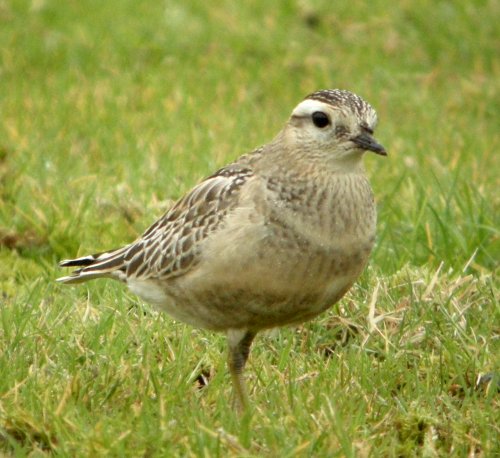
Not a buff-breasted sandpiper!

As it was a nice sunny day and there were no birds around I decided to have a little walk around by the control tower. Whilst doing so three birds zipped over. Two were linnets but the third gave a distinctive bunting trill and as it banked I caught sight in the bins of its chestnut wing panels and with distinctive markings on its face: a nice lapland bunting. There have been so many sightings of these down in Cornwall that it was only a matter of time before one flew over me.

The control tower and small flood pool by the runway at Davidstow

With not much bird action at the airfield and a long journey ahead of me I decided that I should head off back to home and I arrived back in Oxford late afternoon, tired but pleased with my few days birding down in Cornwall.

Saturday 25th September - If Carlsberg did Birding!

Saturday morning I went down to Pendeen watch at 7am where I met another birder though he turned out to be from Berkshire rather than locally. He said that in the half hour he'd been there there'd been nothing through at all apart from two gannets! I joined him and it was remarkably slow going with just a few kittiwakes and auks to show for an hour's watching. At that point I decided that my birding time would more profitably be spent elsewhere and wandered back to the cottage for breakfast.

I needed to hire a circular saw to help chop up a built-in bookcase that the previous cottage owners had installed so it was off to Penzance next. My intention was to pick up the saw and to take a rather circular route back to Pendeen via Treeve Common in order to look for the shrike once more. With very little wind I was thinking that if there bird were still there it would definitely be showing. However these plans were scuppered when I discovered that the hire shop closed at 12 and if I didn't return the saw by then I'd have to wait until Monday. As I was returning to Oxford on Sunday this left me with a bit of a dilemma. In the end I hired the saw, raced back to Pendeen and then spent the next hour or so sawing like a demon, making every conceivable cut that I was possibly going to need so I could actually dismantle it at my leisure. I got the saw back in good time and then decided that Treeve Common was due as a reward for all my hard work.

When I arrived I was initially there on my own. With the calm conditions there were plenty of birds to be seen with whinchat, stonechat and countless meadow pipits zipping around. However there was no sign of the shrike that I could see. Soon after that other people started arriving. First someone from Newquay who was doing a walking circuit of the whole area to check out what was around though he didn't stay long. Then two visiting birders arrived and finally three birders who from their "jizz" were clearly locals. One, who was called Mush (short for Mushtaq perhaps?) was continually on the phone and it turned out that he ran Birdline South West. Another was John Chapple who does the Cornwall birding DVD's. He was carrying a natty little HD digital camcorder on a tripod of which I was rather covetous, especially in the light of the video he subsequently took. There was a third chap whose name I didn't catch. A merlin shot through the field at great speed and was gone almost immediately. John had wandered off to the corner of the field looking for birds whilst the other two chatted so I wandered over to join him. What followed was a few minutes of pure birding magic, hence the blog title "if Carlsberg did birding".

As I approached I saw a warbler flitting through the sallows. It was low down and appeared frequently in the gaps near the bottom so that one could obtain quite good views. Seeing the strong supecilium and some kind of wing bar I suggested "is that a yellow-browed?" John who had been watching it already had been thinking arctic initially but over the next few seconds we converged on greenish warbler! We gestured to the others to come over and in a rather comic manner they dawdled and ambled until we got the message of what we had across to them when they managed to move sharpish enough. A couple of the stragglers didn't manage to see it before it disappeared but most people got at least a glimpse.


Some video that John Chapple took of the greenish warbler the next day

A minute or so after it had disappeared and whilst we were looking around to see if we could see it again John noticed something in the overgrown ditch next to us. "Is that a hippolais?" he asked. It turned out to be a melodius warbler working its way along the ditch. It then appeared in the sallows where the greenish had been. It worked its way back and forth a few time and I even managed to take a couple of digiscoped shots of it though trying to digiscope a skulking warbler in sallows is bloody hard work.


My digiscoping efforts for the melodius warbler

We hung around for a bit longer to see if the greenish would return though it didn't and was not seen again that day (though John re-found it the next day). Whilst waiting the merlin shot through again but the shrike never turned up and the melodius started to get elusive. I realised that I would have to get back to the cottage to get on with my DIY and so headed off back to Pendeen.


John Chapple's video of the melodius warbler

I spent the next few hours getting hot and dusty but managed to dismantle the bookshelf, pack it into the car and take it to the St. Erth recycling centre. Whilst there I thought that it would be rude of me not to pop in to Hayle estuary where I passed a pleasant while checking out the high tide roost though there was nothing particularly unusual about so I headed back home to Pendeen to finish clearing up all the mess I'd made from the day's work

Friday 24th - Davidstow & Treeve Common

I was due back down in Cornwall for more work on the cottage so on Friday I set off from Oxford mid morning and headed west. This time I thought that I'd stop in at Davidstow Airfield, partly as though I'd heard much about it and its ability to bring in rarities I'd never actually visited and partly as there were currently two dotterel and a buff-breasted sandpiper in residence.

When I arrived it was rather overcast and gloomy with occasional brief showers. I pulled off onto the end of the main runway and a quick scan found a flock of about 10 ringed plover with one dunlin. I wondered how one was supposed to bird this location and had naively assumed that one parked up and scanned with a scope though his did make me wonder how people got such good photos from their cars at close quarters. I then saw a car on the airfield in the distance and realised that the answer was that people just drove around in their cars until they found something. I decided to follow the other car and this turned out to be a good plan because it ended up next to another car whose occupants were watching the two dotterel at close quarters.

The two dotterel, taken with my point & shoot camera

I took a few rubbish record shots with my point & shoot camera and wondered about digiscoping. To get out of the car would risk flushing the birds so in the end I tried hand-holding the scope with my digiscoping camera attached to the end and the results came out quite well.


Hand-held digiscoped dotterel.

There were also loads of wheatears around as well as some pied and white wagtails, meadow pipits and linnets. Despite searching for some time and asking other birders there appeared to be no sign of the sandpiper so I headed on to Penzance.

When I arrived I thought that whilst it was still light I'd head straight over to Treeve Common near Sennen/Land's End to see if I could find the red-backed shrike that was there. Whilst it was nice and sunny down there there turned out to be a very strong northerly wind and all the birds were hunkered down out of sight and there was no sign of the shrike. So I headed down to Pendeen and checked in at the Watch for half an hour though nothing went through apart from a couple of manx shearwaters. Then it was off to unpack the car, "boot up" the cottage and go and get some food for the weekend.

The Wra from the watch, bathed in golden sunlight.
Shame about the lack of birds though.